Showing posts with label Film Reviews. Show all posts

Saturday, 15 October 2016

2001: A Space Odyssey (1968) Film Review


 Stanley Kubrick’s 2001: A Space Odyssey (1968) is an epic science fiction film that has engrossed many audiences through its staggeringly accurate depiction of future spacecraft. It is comprised of an untraditional plot in which portrays the developments of the human race as a whole rather than focus on telling the story of a single character, telling 2001 in four chapters. With these intentions, Kubrick’s revolutionary production design is so authentic that it becomes a film way ahead of its time, not just artistically, but through advancing technological spacecraft in the real world highly enough that in 1969, man walked on the moon for the very first time.

The first chapter “The Dawn of Man” depicts the everlasting desire for mankind to gain mental superiority over one another through two tribes of apes – this of which is initiated by a mysterious black monolith. The dry and barren but colourful atmospheres that surround them represent the emptiness and nothingness of the universe when simply using it as a means to survive rather than to live, but as a single ape discovers and teaches other apes the rule of survival of the fittest, the later arrival of the monolith encourages an interest from the other apes. It is interesting how the fascinating monolith juxtaposes with the unproductive scenery as it depicts that the establishment of the human mind was widely expanded through science and exploration, and through mans own will.


Figure 1:


All of the chapters are portrayed in an unpretentious manner, as a means to depict the characters and the spacecraft to be natural as if they didn’t have to put on an act for viewing audiences. This is especially demonstrated through chapter two “Tycho Magnetic Anomaly one” in which Kubrick tries to initiate that the advancement of a spaceship could become so common that they would not need to forcefully emphasise the greatness of it to audiences. Along with this, they also display the spaceship to have numerous similarities to an airport, along with living environments so crew members could simply use the spacecraft to relax as well. The fact that all of the different rooms have boldly different colours and bright tones could emphasise their recognisable individual functions, but they could also be chosen as a means to display their level of risk to the crew members, such as the room that Frank talks to his family from is white for innocence and emptiness and the colour of the room which programs HAL 9000 is red to be threatening.

Figure 2:


It is significant that there is little dialogue or music during the course of the movie, and it is noted that there is no dialogue during the first quarter and last quarter of the film. This is technically because in space there is no sound. However, this intention to also be to emphasise the impact of the interior and exterior design of the spacecraft. Angie Errigo states: “Its faults - sketchy narrative, overblown abstraction - are counterbalanced by its gripping engagement between man and machine, and its rhapsodic wonder at heaven and earth and the infinite beyond” and much of the stylized technology has been used in many Sci-Fi films today, such as the Star Wars saga and Blade Runner. As the movie progresses, it is evident that much of the colours of the set designs are primary colours that contain rigid outlines, however, there is also a heavy use of very basic black and white tones to emphasize that despite the artistic qualities of the set, it is displayed and design for function purposes.  Chapter two expresses an array of spectacular shots in which exceedingly cover the whole of the spaceship, such as through using long panel shots to cover a tunnel like perspective view, along with using the sets creatively to display the absence of gravity and the ways in which the crew can exploit this.


Figure 3:


The final chapters of the film become more compelling than the previous ones due to the fact that they convey an obvious plot, and they also demonstrate the characters’ actions as being critical for their own survival – especially Dave’s. A particular catalyst that supports this is when the HAL 9000 – the brain and central nervous system of the spacecraft starts to turn against the crew members of the ship even though he is programmed to be fool proof and incapable of error. Everything around the spaceship seems to close in and the colours are more dark and denser to resemble that the life support of the ship is crashing, showing a less glamorous side of the ship, however, due to this we see a more interesting character development as Dave is forced shut down the spacecraft to save Frank.

The final chapter “Jupiter and beyond the Infinite” is a challenging concept to understand by some viewers, as it incorporates the idea that man has to understand his mortality, and that new unknown life is constantly emerging beyond the cosmos. It also in some ways concludes the development of man in conjugation with the first chapter demonstrating the start of mans life. The deliberately antique room in which inhabits numerous forms of mans life demonstrates the fact that no earthly actions can prepare man for life outside of earth. It is also interesting how Dave sees older versions of himself as he explores the rooms as if he is consciously looking towards the future in the aid of personal development, judging oneself from the outside. A particularly challenging moment involves Dave witnessing an older version of himself drop a wine glass – perhaps signifying that despite a container, the liquid still exists and mirroring the concept of death when the body no longer remains but the spirit will continue to exist. The monolith also returns to the final stage of Dave’s life as a bedridden old man, perhaps foreshadowing how the later existence of technology will also be just as significant on him evaluating his life. However, the big finale which displays a particularly intelligent technique portrays Dave going through a stargate sequence after defeating HAL and as he is being transported light years into the universe, the monolith is presumed to be showing him things that he’d never have the ability to see for himself. Through this is views other phenomena of life forms and there is a part in the stargate sequence which shows the Monolith possibly showing Dave the big bang – this is demonstrated through Dave’s eyes continuing to blink and change colour, emphasising his new wave of understanding.

 
Figure 4:


Bibliography:

Reynolds, D. and more, S. (2013) What does the ending of 2001: A space odyssey really mean? Available at: http://whatculture.com/film/what-does-the-ending-of-2001-a-space-odyssey-really-mean?page=2 (Accessed: 15 October 2016).

Snow, R. (2011) Reviews of classic movies: ‘2001: A space odyssey’. Available at: https://robertsnow.wordpress.com/2011/08/26/review-2001-a-space-odyssey/ (Accessed: 15 October 2016).

Willans, J., Nybergh, T., Caretti, R., Kurkijärvi, K., Anderson, J., Aulén, M., Harris, K., Tamminen, L. and Järventaus, A. (2013) 17 little known facts about 2001: A space odyssey. Available at: http://inktank.fi/17-little-know-facts-about-2001-a-space-odyssey/ (Accessed: 15 October 2016).

(Willans et al., 2013)
Zárate, I. (2015) The cultural impact of Kubrick’s 2001: A space odyssey. Available at: http://moviepilot.com/posts/3605468 (Accessed: 15 October 2016).
(Zárate, 2015)


Illustration List:

Figure 1:

Figure 2:

Figure 3:

Figure 4:


Sunday, 2 October 2016

Film Review of Fritz Lang's Metropolis

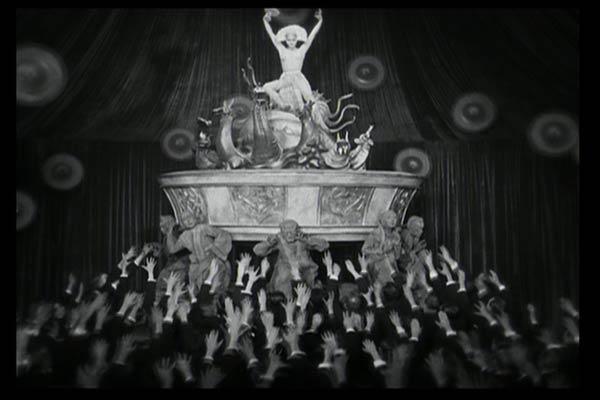
Fritz Lang’s Metropolis (1927) is a German expressionist science-fiction silent film that is widely known for being the originator of most Sci-Fi films. Along with its set design being phenomenally significant, it also works as inhabiting numerous themes explored within the film, such as deception, death, and destruction. The definition of the word metropolis itself means a large and representative city, and the sets are so grand and intimidating that the characters are forced to live up to the grandeur of the city. As Fritz Lang’s Metropolis epitomises the definition of the word metropolis, it however portrays much more character through its cast and plot.

Presented as a running city with a beautiful art-deco inspired design, the surface of the city embraces the spirit of the 1920s, a time in which was a profitable paradise of cultural edge and economical prosperity, yet the depths of the city greatly contrast by depicting the harsh and discriminatory consequences of the work that goes into powering the city through the suffering of the workers. Expressed to Freder during the early stages of the movie, Maria states: “These are you brothers” implying that his carelessness in enjoying his father’s wealth is a destructive force towards those that are suffering for his happiness. That to which he later decides to investigate, Freder becomes horrified to see the conditions that the workers are in and even volunteers to work a machine whilst the worker takes a break. Perhaps his compassion for the workers comes from his understanding of what it is like to be “Dismissed…and sent to the depths” by his father as we also discover that his father, although wealthy, is a high strung man who has little disregard for others concerns. It could be said that to be dismissed by Roh to the depths is to be dismissed by God and sent to Hell. An example of Freder’s father, Roh’s wealth is displayed through his office, but for effect, all of the objects within his office are dramatically oversized to enforce empowerment over those below his position. Another effective use of Roh’s wealth is displayed through his garden in which inhabits exotic wildlife and a luxurious fountain.

Jane Barnwell states that Metropolis was: “a landmark in terms of concept & technical achievement… and was so visually ground breaking that its influences are still in existence today, and they can be identified most in Steven Spielberg’s A.I: Artificial Intelligence (2001)”. Other features in Metropolis that have been highly influential to other films include the character of Maschinenmensch, which portrays strong similarities to the character of C3P0 George Lucas’s Star Wars films, along with the character of Evelyn Seymour in Noel Pemburton Belling’s High Treason (1925) showing similar characteristics as the character Maria.

The notable qualities of the production design and settings in Metropolis is that they work as being either havens for the characters or threats. With the mechanisms of the factory in Metropolis being a threat, the workers work in syncronised movements, and the strain of their work has forced them to lose their identity and has inflicted them to work the same way as the machines they are powering. A contrasting example is the Church and the underground Chapel run by Maria, in which work as a haven for the workers to plan their escape from the work that is destroying them. The design of the factory includes using a steep staircase, institutionalized work stations, steam powered units and a labour intensive set up to threaten the workers. It is notable that the character of Freder views their work as being so horrific that he imagines them as being treated like slaves forced into a temple that devours them. It is obvious that this is highly dramatized due to the film’s influence from the story of ‘The Tower of Babel’; Maria even states that “Today I shall tell you of the Tower of Babel” in which the workers similarly want to plan an escape to “reach a heaven” out of the city, but are labelled as disrespectful in the thought of doing so by the head of the city Roh Frederson. Despite films futuristic plot, Lang it uses the idea of religion and past ideas to ground the workers, which is possibly why Maria makes speeches to the workers in the underground of the city; where the setting is manmade and untainted.

A different of the settings being used as threatening within the film include the underground staircases and tunnels in which C.A Rotwang chases Maria, as they work as being claustrophobic devices to portray a lack of direction and escape. They also aid in providing an imprisonment, such as when Freder is pursuing Maria and the body of doors keep closing him in, trapping him from being able to save Maria. The remarkable device of the torch that Rotwang uses to “expose” Maria also assists in adding terror as her reactions inflict terror upon the audience.

During the final scenes of the movie in which the city begins to flood, it is significant that the gong in which Maria bangs continuously to call for help is portrayed as being challenging to use. It is also significant that the children of the worker’s crowd around her below her platform, as this aids in portraying her as a figurehead that the workers look up to. The gong demonstrates an example of difficulty that the workers face when trying to seek help, and the fact that the gong doesn’t make any noticeable sound even during an emergency also demonstrates the lack of care that the workers receive. The workers homes also depict such plain and discouraging designs, which also promotes the fact that the workers feel imprisoned.

A merrier example of the use of set design is during the social gathering in which Joh and C.A. Rotwang attend, and they experience the atmosphere brought on by the Maschinenmensch disguised as Maria. Using the same impact of a gathering, such as gatherings thrown in Baz Luhrmanns’ The Great Gatsby (2012), the ambience exceedingly becomes so mesmerizing due to “Maria” seducing the guests by dancing, and the guests become so engulfed by her that they agree to rebel against the power of Metropolis. Stating that the workers have “Lubricated the machine joints with their own blood…” and “Fed them with their own flesh” “she” urges them to “let the machines starve, you fools!”. Whilst all of this is happening, Freder is being supposedly nursed back to health in bed, but it is so overdramatized that he is portrayed to be on his death bed, and to prove this point would be when Freder envisions a Pope visiting him stating the Maschinenmensch’s teachings. He eventually arrives at the gathering stating that “Maria speaks of peace, not killing”, however, the workers join forces against him despite his innocence as he is the son of their torturer - Roh.

The overall fulfillment of the film comes from realizing that a grand city such as Metropolis should be build with the head and hands, using the heart as a mediator. Siegfried Kracaucer states that “Metropolis was rich in subterranean content that, like contraband, had crossed the borders of consciousness without being questioned.” (Phillip 2015). To this extent, Metropolis is a film way ahead of its time because it combines numerous interesting scenarios and allows them to rely on the existence of the the city of Metropolis in which to utilize them.


Illustration List:


http://vigilantcitizen.com/wp-content/uploads/2010/10/metro51.jpg


Figure 1


Figure 2 - http://pyxurz.blogspot.com/2011/10/metropolis-page-1-of-6.html


Figure 2


Figure 3 –  http://metropolisbabylon.blogspot.co.uk/2015/04/apocalyptic-visions-in-fritz-langs.html


Figure 3


Figure 4

Bibliography:

Barnwell, J. (2003) Production design: Architects of the screen. LONDON: Wallflower Press
Bradshaw, P. (2010a) Metropolis. Available at: https://www.theguardian.com/film/2010/sep/09/metropolis-restored-film-review (Accessed: 2 October 2016).
French, P. (2015) Metropolis review – Philip french on Fritz Lang’s visionary epic. Available at: https://www.theguardian.com/film/2015/mar/15/metropolis-fritz-lang-philip-french-classic-dvd (Accessed: 2 October 2016).
sjfilmhistory (2014) The influence of Fritz Lang’s ‘metropolis’ on future films. Available at: https://sjfilmhistory.wordpress.com/2014/02/03/774/ (Accessed: 2 October 2016).

Metropolis (1927) Directed by Tomatometer .